
Macular degenerationGold Coast & Tweed Heads
Affects the centre of your retina, which you use for reading, faces and fine detail. Dry AMD usually changes slowly; wet AMD can change quickly, and treatment is available for many people.
- Dry and wet AMD
- Anti-VEGF injections
- OCT monitoring
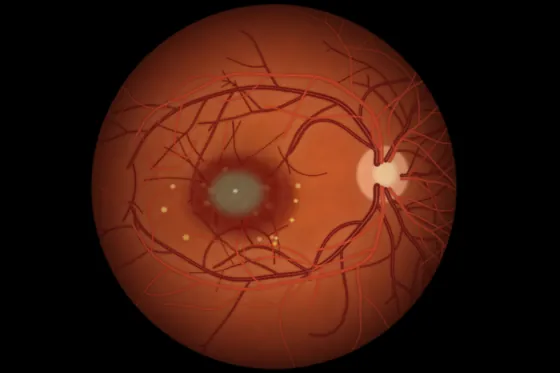
The short version
- What is it?
- Wear and tear of the macula, the centre of the retina you use for reading and faces. Side vision is not affected.
- Will I lose my sight?
- AMD does not cause total blindness, because side vision is kept. Central vision can be affected, slowly in dry AMD and more quickly in wet AMD.
- Can anything be done?
- Wet AMD can often be stabilised with regular eye injections. For dry AMD, vitamins, not smoking and regular checks help, and newer treatments may slow geographic atrophy in some people.
- What does treatment involve?
- For wet AMD, a quick injection in the rooms after numbing drops, repeated every few weeks to months, with a scan each visit.
- What if I do nothing?
- Dry AMD may change slowly over years. Untreated wet AMD usually causes lasting loss of central vision.
The key facts
What you may notice
- Wavy or distorted straight lines
- Difficulty reading or recognising faces
- A blurred or dark patch in central vision
How it is diagnosed
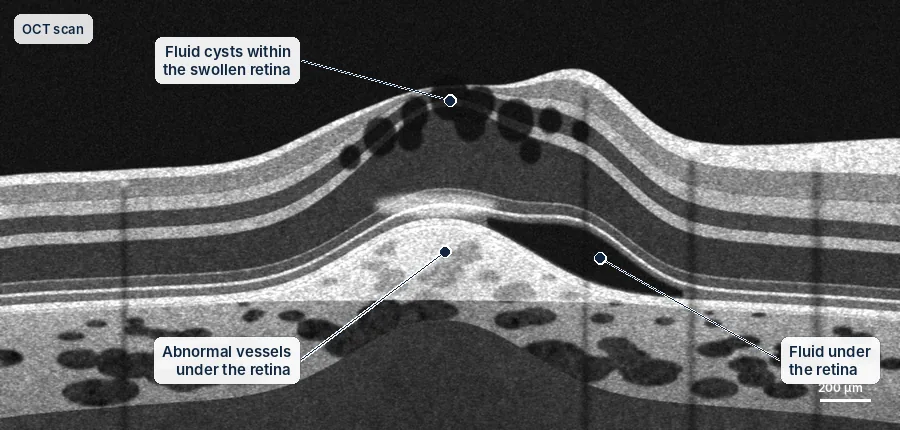
- OCT scan to look for fluid
- Fluorescein angiography when needed
- Amsler grid checks at home
How it is treated
- Wet AMD: anti-VEGF injections into the eye
- Treatment intervals tailored to your OCT scans
- Dry AMD: monitoring and lifestyle advice; newer treatments may slow geographic atrophy
Recovery
- Each injection takes a few minutes in the rooms
- Regular review keeps the disease under control
- Report any new distortion promptly

Dr Travers Weaver
Dr Weaver gives injections in his own rooms at Robina and Tweed Heads, with a scan at each visit to guide the timing of your next injection.
- FRANZCOSpecialist eye surgeon
- 2 extra yearsRetinal surgery training, Vancouver
- About 1,000Operations a year
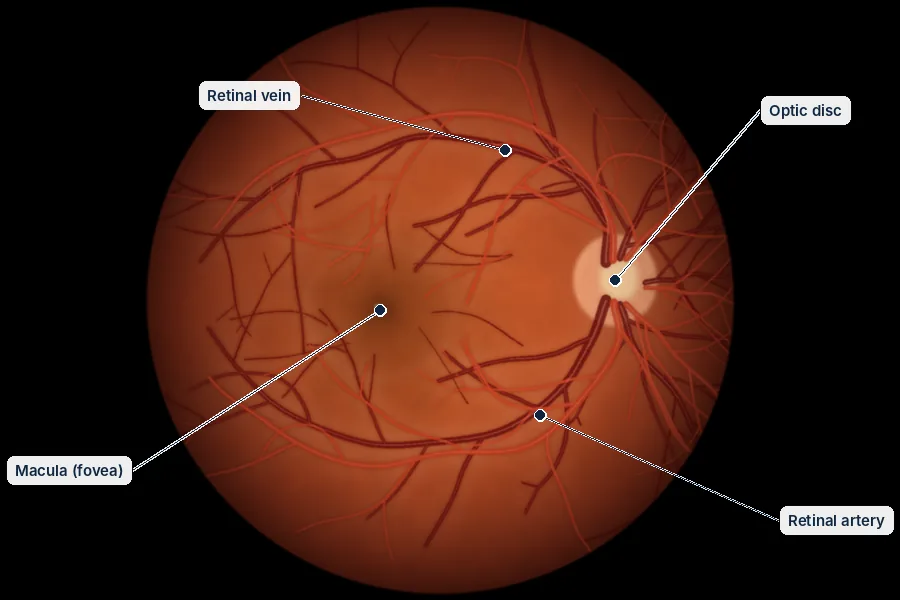
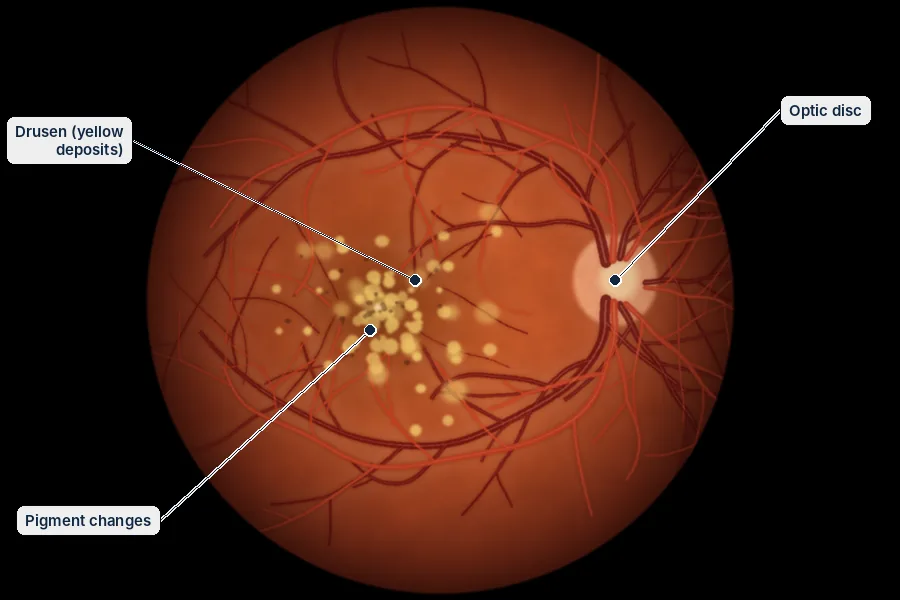
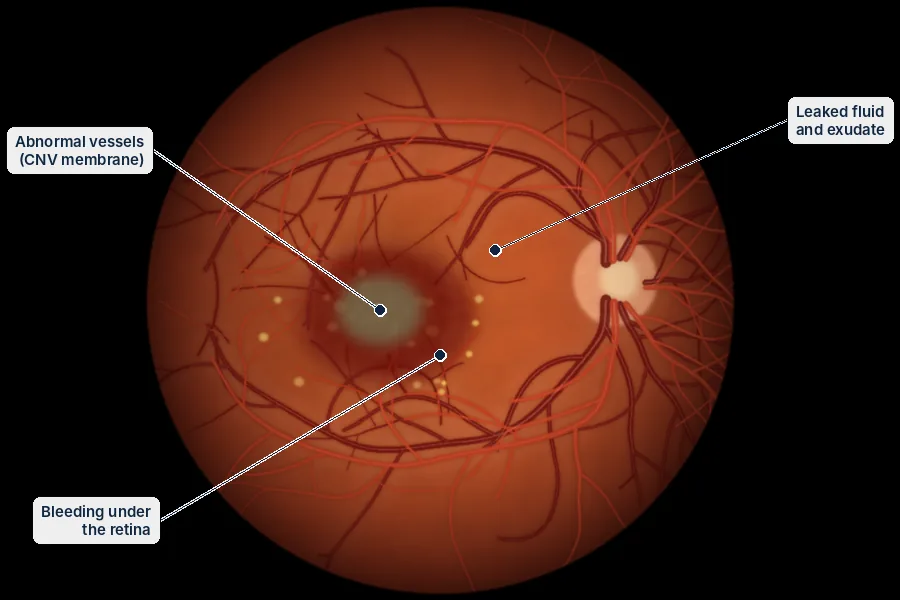
Inside the eye
Dry AMD causes yellow drusen deposits; wet AMD involves abnormal vessels that leak fluid and blood.
Simplified diagrams for patient education, not to scale.
Understanding the risks
Every procedure carries some risk. These are approximate rates from published studies, grouped by how often they happen. They are averages, not a prediction for you; Dr Weaver will discuss your own risks before any treatment.
Aftercare guides| Risk | Approximate rate |
|---|---|
| Common, usually temporary or manageable | |
| Brief rise in eye pressure | Common, settles within minutes to hours |
| Red spot on the white of the eye or new floaters | Common and harmless, settles in days |
| Rare but serious | |
| Infection inside the eye (endophthalmitis) | About 1 in 2,000–3,000 injections |
| Retinal tear or detachment | Rare, about 1 in 5,000–10,000 injections; the risk adds up over many injections |
| Injury to the lens (cataract) | Rare, about 1 in 10,000 injections or fewer |
Everything you need to know
Tap a topic to open it.
Understanding the macula
The macula is a small area at the centre of the retina, the light-sensing layer at the back of the eye. It gives you sharp, detailed central vision for reading, recognising faces and driving. Age-related macular degeneration (AMD) slowly damages the cells in the macula, so central vision is lost. Side vision is not affected.
AMD is the leading cause of permanent vision loss in Australians over 50. About 1 in 7 people over 50 have some sign of it. Finding it early and treating it on time are the best ways to protect your sight.
Dry AMD: the most common form
About 85 to 90 in every 100 people with AMD have the dry form. Small yellow deposits called drusen build up under the retina, and the macula slowly thins. Vision usually changes slowly, over years, although the loss can become significant.
In its advanced stage, dry AMD can become geographic atrophy. Patches of the macula waste away completely, leaving a permanent blind spot in the centre of your vision.
Looking after dry AMD means regular checks and slowing it down where possible:
- Regular OCT scans to look for change, or for a switch to wet AMD
- AREDS2 vitamin supplements (lutein, zeaxanthin, vitamins C and E, and zinc). These lower the risk of getting worse in people with moderate AMD, or advanced AMD in one eye.
- Stopping smoking, as smoking makes AMD worse faster
- Good-quality sunglasses
- A Mediterranean-style diet with leafy greens and oily fish
- Checking each eye every day with an Amsler grid, so any change to wet AMD is picked up quickly
Geographic atrophy: new treatment options
Geographic atrophy (GA) is the advanced stage of dry AMD. Patches of the macula slowly waste away, and the patches grow over months and years. Early on, you may need more light to read, find that words go missing from a line, or find faces harder to make out. GA does not cause sudden bleeding like wet AMD, but vision that is lost cannot be brought back.
Until recently, there was no treatment for GA other than monitoring and low-vision support. Newer treatments, given as regular injections into the eye, can slow how fast the patches grow in some people. They do not stop GA, reverse it or bring back lost vision. They also need to be continued long term, so they are not right for everyone.
Whether treatment is worthwhile depends on the size and position of the patches, how fast they are growing, the vision in each eye and what matters most to you. Options for GA are changing quickly. A treatment being approved in Australia does not always mean it is subsidised by the PBS, so it may be expensive to pay for yourself. Costs vary. Dr Weaver can talk you through the current options, including the likely benefits, risks and costs, and any clinical trials that may suit you.
Monitoring GA: regular OCT scans and wide-field photographs measure the patches over time. People with GA can also develop wet AMD, so keep checking each eye with an Amsler grid and report any new distortion promptly.
Wet AMD: needs urgent treatment
Only about 10 to 15 in every 100 people with AMD have the wet form, but it causes most of the severe vision loss. Abnormal new blood vessels grow under the retina. These vessels are fragile. They leak fluid and can bleed, which quickly blurs and distorts central vision.
Wet AMD can change vision quickly, sometimes over weeks, so it needs prompt assessment. How fast it changes varies from person to person. If you notice new distortion, blurring or a dark patch in your central vision, call Dr Weaver's rooms urgently. Check each eye with your Amsler grid every day between appointments.
Urgent: new distortion or a change in vision
If straight lines on your Amsler grid suddenly look wavy, bent or missing, or you notice a new dark or grey patch in your central vision, call Dr Weaver's rooms the same day. Do not wait for your next routine appointment.
Injection treatment for wet AMD
Injections into the eye are the standard treatment for wet AMD. The medicine blocks a protein called VEGF, which makes the abnormal vessels grow and leak. With treatment, the vessels shrink and the fluid dries up.
What treatment can and cannot do:
- The main aim is to keep the vision you have and stop it getting worse.
- Some people find their vision improves.
- Vision that has already been lost often does not fully come back.
- Treatment is usually ongoing, with regular injections and scans.
What happens at an injection
Getting ready
Numbing drops are put in, then a small injection of local anaesthetic numbs the surface of the eye. The eye is cleaned with antiseptic, usually chlorhexidine. The whole procedure takes only a few minutes.
The injection
A very fine needle puts a tiny amount of medicine (about one drop) through the white of the eye. Most people feel brief pressure, or nothing at all.
Afterwards
You may notice a few more floaters, or a small red patch on the white of the eye. Both are normal and settle within days. Vision can be a little blurry straight after the injection, but this soon clears. You go home the same day.
Which medicine?
Several medicines are available in Australia. They work in a similar way, and some allow longer gaps between injections. Dr Weaver will talk with you about which medicine and schedule suit your eye, based on your scans and how your eye responds.
After an injection
- Do not rub the eye for 24 hours
- Avoid swimming pools, spas and dusty places for 48 hours
- Use any drops you are given as directed
- Call urgently if your vision gets much worse, or the eye becomes more painful or more red, or you have many more floaters than before. These can be signs of infection inside the eye (endophthalmitis). This is rare but needs treatment the same day.
- You can drive the next day. Do not drive on the day if your vision is affected.
How often, and for how long
Treatment for wet AMD is ongoing. Most people start with an injection every month for the first few months. After that, the gap between injections is gradually stretched out, depending on what your scans show (this is called treat and extend). Dr Weaver checks your scan at each visit and adjusts the timing. Some people keep stable vision with an injection every 3 to 4 months.
Checking your vision at home
Dr Weaver asks everyone with wet AMD to check their central vision every day with an Amsler grid. Test each eye on its own, with your reading glasses on. If straight lines look wavy or bent, or a new dark patch appears, call the rooms that day. Do not wait for your next appointment. Amsler grids are available from the practice.
Macular degeneration: common questions
How is wet macular degeneration treated?
Wet AMD is treated with injections of medicine into the eye, given in the rooms. Treatment usually starts with monthly injections, then the gap between injections is extended based on your OCT scans. Starting treatment early gives the best chance of keeping your vision, so new distortion or blurring needs prompt review.
What is the difference between wet and dry macular degeneration?
Wet AMD occurs when abnormal blood vessels grow under the macula and leak fluid or blood. It can reduce vision within days to weeks and is treated urgently with injections into the eye. Dry AMD is the more common form. It causes yellow deposits (drusen) and gradual thinning of the macula over years.
Is there treatment for dry AMD?
For early and moderate dry AMD, the focus is on regular checks, not smoking, a healthy diet and, for some people, AREDS2 eye vitamins. Geographic atrophy is the advanced stage of dry AMD. For some people, newer treatments given as regular eye injections can slow how fast it grows. Dr Weaver can discuss whether these are suitable for you.
What is geographic atrophy?
Geographic atrophy is the advanced stage of dry AMD, in which patches of the macula gradually waste away. It causes slowly worsening central vision, such as difficulty reading or recognising faces. Vision lost to geographic atrophy cannot be restored.
Can dry AMD turn into wet AMD?
Yes. Dry AMD can change to wet AMD at any stage. Check each eye with an Amsler grid regularly, and call the rooms promptly on (07) 5612 5200 if you notice new distortion, blurring or a dark patch.
Do eye vitamins help macular degeneration?
AREDS2-formula supplements have been shown to lower the risk of progression in people with intermediate AMD, or advanced AMD in one eye. They are not shown to help people with no AMD or only early changes. Ask Dr Weaver whether they suit you, particularly if you take other medicines.
You may also want to read
Talk to Dr Weaver about your eyes
A referral from your GP or optometrist is needed to claim Medicare rebates. Our team can help with bookings at Robina and Tweed Heads.