
Floaters & flashesGold Coast & Tweed Heads
Most floaters are harmless. A sudden shower of new floaters or flashes needs an urgent check for a retinal tear.
- Urgent check for new floaters
- Most need no treatment
- Vitrectomy in selected cases
Symptoms can be urgent. New floaters, flashes, a shadow or sudden vision loss need same-day assessment. Call (07) 5612 5200, or after hours go to the emergency department at Gold Coast University Hospital.
The key facts
What you may notice
- Dots, threads, cobwebs or rings that drift
- More noticeable against a bright sky or white wall
- New floaters with flashes need an urgent check
How it is diagnosed
- Dilated examination of the whole retina
- OCT and wide-field retinal photographs
- Ultrasound if blood blocks the view
How it is treated
- Most floaters need no treatment
- Any cause found, such as a tear, is treated
- Vitrectomy for persistent, troublesome floaters
Recovery
- Floaters usually become less noticeable over months
- A review is often advised 4–6 weeks after new floaters
- Know the warning signs of a retinal tear

Dr Travers Weaver
Dr Weaver can examine the whole retina, treat a tear with laser in his rooms, and perform vitrectomy if floaters or a detachment need surgery.
- FRANZCOSpecialist eye surgeon
- 2 extra yearsRetinal surgery training, Vancouver
- About 1,000Operations a year
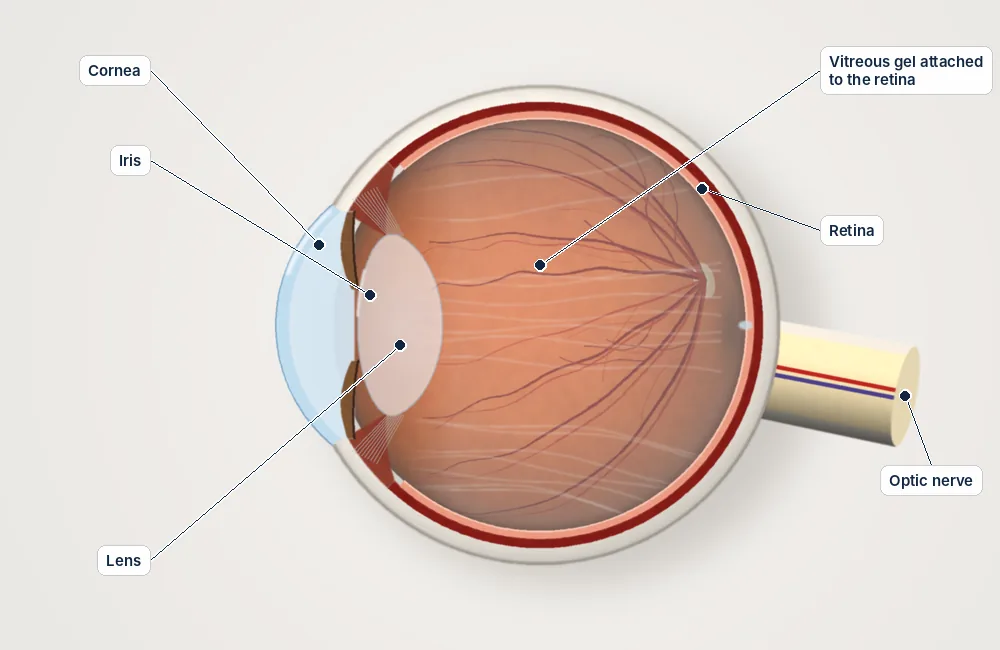
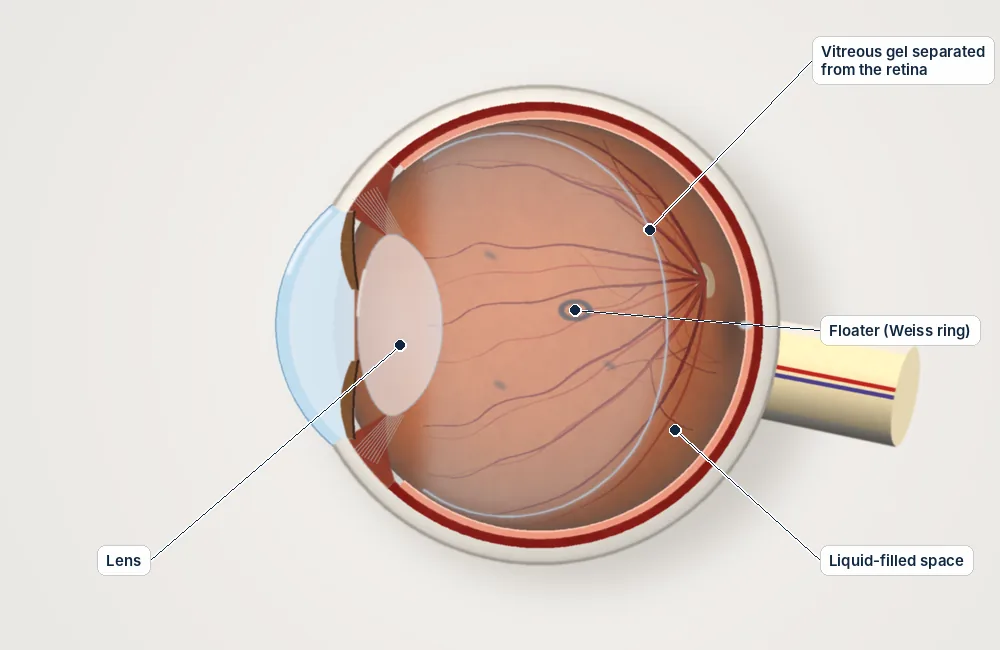
Inside the eye
As the vitreous gel separates it can cause floaters and flashes; occasionally it tears the retina.
Simplified diagrams for patient education, not to scale.
Understanding the risks
Every procedure carries some risk. These are approximate rates from published studies, grouped by how often they happen. They are averages, not a prediction for you; Dr Weaver will discuss your own risks before any treatment.
Aftercare guides| Risk | Approximate rate |
|---|---|
| Common, usually temporary or manageable | |
| After floater vitrectomy: cataract | Most people over 50 within 1–2 years |
| Uncommon | |
| After floater vitrectomy: retinal detachment | About 1–2 in 100 |
| Rare but serious | |
| After floater vitrectomy: infection inside the eye | About 1 in 2,000–3,000 |
Everything you need to know
Tap a topic to open it.
What are floaters?
Floaters are small specks, threads, cobwebs or rings that drift across your vision. They are shadows cast on the retina by clumps or strands in the vitreous gel that fills the back of the eye. They are very common, are easiest to see against a bright sky or a white wall, and most are harmless.
What causes floaters?
Common causes
- Posterior vitreous detachment (PVD): the normal age-related separation of the gel from the retina, the most common cause of new floaters
- Short-sightedness (myopia): floaters often appear at a younger age
- After cataract surgery or YAG laser to the lens capsule
Less common and rarer causes
- Retinal tear or retinal detachment
- Bleeding into the gel (vitreous haemorrhage), for example from diabetic eye disease, a retinal vein occlusion or a retinal tear
- Inflammation inside the eye (uveitis)
- Infection inside the eye, after surgery or an injection, or spread from elsewhere in the body
- Asteroid hyalosis: harmless calcium-like deposits in the gel
- Eye injury
- Rarely, lymphoma of the eye or other tumours, which can cause persistent floaters and haze
Warning signs — seek urgent assessment
- A sudden shower of new floaters
- New flashes of light
- A shadow or curtain spreading across your vision
- Sudden blurring or loss of vision
During business hours call the rooms on (07) 5612 5200 the same day. After hours, go to the emergency department at Gold Coast University Hospital. A retinal tear treated early with laser can prevent a retinal detachment.
Assessment
Your pupils are dilated so the whole retina, including the far edge, can be examined with gentle indentation. OCT and wide-field photographs record what is found, and ultrasound is used if blood blocks the view. After a new posterior vitreous detachment, a second check is often advised at 4–6 weeks, because a tear can still develop in the weeks after symptoms start.
Treatment for troublesome floaters
Most floaters need no treatment. They tend to settle lower in the eye and the brain learns to ignore them, so they become much less noticeable over weeks to months. When persistent floaters interfere with reading, driving or work, options include:
- Vitrectomy: the vitreous gel and floaters are removed in day surgery. It is the most effective option for troublesome floaters, but it carries the small risks of eye surgery, including cataract, retinal tear or detachment and infection.
- YAG laser vitreolysis: a laser is used to break up a floater. This is the least preferred option: only some floaters are suitable, results are less predictable and the laser carries its own risks.
Dr Weaver will discuss whether treatment is worthwhile for you, weighing how much the floaters affect you against the risks.
Floaters & flashes: common questions
Are floaters serious?
Most floaters are harmless. A sudden shower of new floaters, flashes of light or a shadow in your vision can mean a retinal tear or detachment and needs an urgent check the same day.
Will my floaters go away?
Floaters rarely disappear completely, but they usually become much less noticeable over weeks to months as they settle and the brain learns to ignore them.
Can floaters be removed?
Yes. Floaters that do not settle can be removed with vitrectomy surgery. Because surgery has small risks, it is kept for floaters that really affect daily life.
You may also want to read
Talk to Dr Weaver about your eyes
A referral from your GP or optometrist is needed to claim Medicare rebates. Our team can help with bookings at Robina and Tweed Heads.