
Dislocated IOL & sutured lensGold Coast & Tweed Heads
Repositioning or replacing a lens implant that has moved, including scleral-fixated and sutured lenses.
- Vitrectomy
- Scleral fixation
- Day surgery
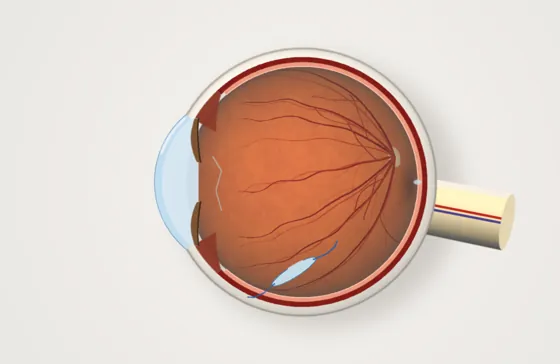
The key facts
What you may notice
- Sudden blurred or double vision
- Seeing the edge of the lens
- Vision that changes with head position
How it is diagnosed
- Slit-lamp examination
- Ultrasound to locate the lens
- OCT to check the macula
How it is treated
- Vitrectomy to retrieve the lens
- Repositioning or exchange of the implant
- Fixation to the wall of the eye when support is weak
Recovery
- Eye drops for several weeks
- Vision settles over a few weeks
- Glasses updated afterwards if needed

Dr Travers Weaver
Dr Weaver performs both retinal and lens surgery, so a lens that has dropped into the back of the eye can usually be removed and replaced in one operation.
- FRANZCOSpecialist eye surgeon
- 2 extra yearsRetinal surgery training, Vancouver
- About 1,000Operations a year
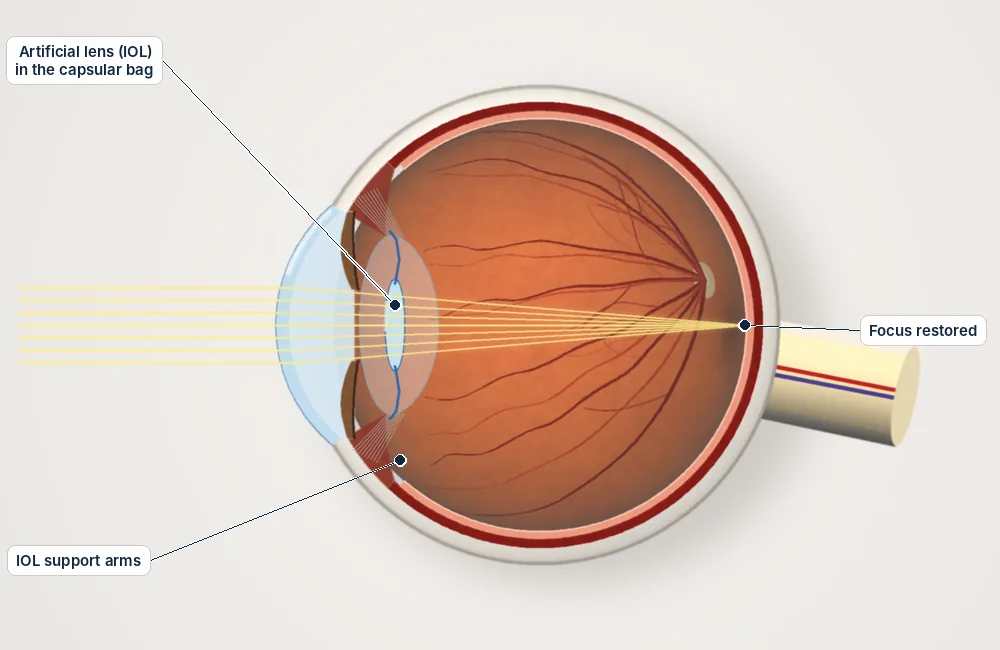
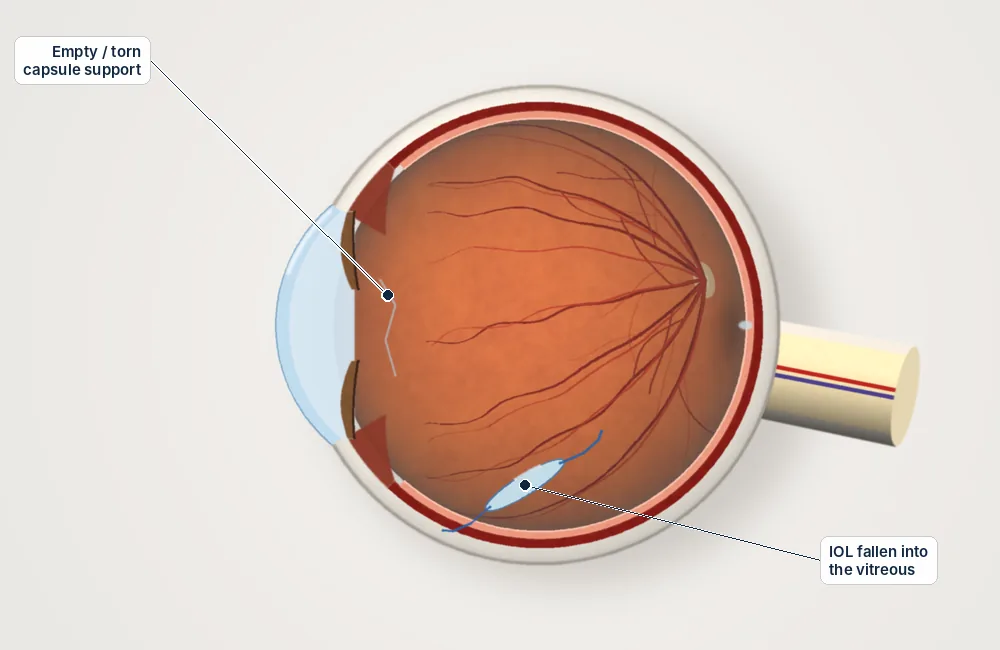
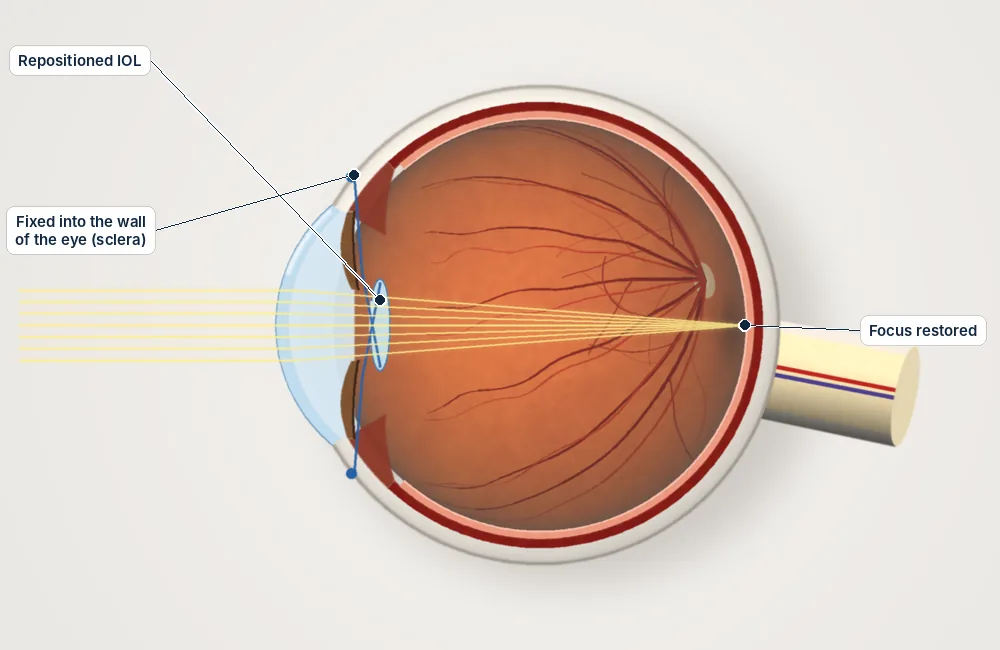
Inside the eye
A lens implant can shift out of position years after surgery; it can be repositioned or replaced and fixed to the eye wall.
Simplified diagrams for patient education, not to scale.
Understanding the risks
Every procedure carries some risk. These are approximate rates from published studies, grouped by how often they happen. They are averages, not a prediction for you; Dr Weaver will discuss your own risks before any treatment.
Aftercare guides| Risk | Approximate rate |
|---|---|
| Common, usually temporary or manageable | |
| Raised eye pressure | Common, usually temporary |
| Uncommon | |
| Swelling at the macula (CMO) | About 5–10 in 100 |
| Retinal detachment | About 1–2 in 100 |
| Lens tilt or decentration | Uncommon |
| Rare but serious | |
| Infection inside the eye | About 1 in 1,000 |
Everything you need to know
Tap a topic to open it.
Overview
Dr Weaver has a particular interest in repairing lens implants that have moved out of place, and in eyes that have no lens. He repositions or replaces lens implants, and fixes new lenses to the wall of the eye, at Miami Private Hospital and Pacific Private Hospital on the Gold Coast.
Why do lens implants move?
After cataract surgery, the lens implant sits inside a thin, clear bag (the capsule). The bag is held in place by hundreds of tiny fibres (zonules), like a trampoline held by springs. A lens implant moves out of place when this support fails:
- Late movement, years after cataract surgery: the most common cause in older people. Over time the bag shrinks and the fibres weaken, so the bag and lens together slip or drop into the back of the eye. This is more likely with a condition called pseudoexfoliation, with high short-sightedness, or after inflammation in the eye (uveitis).
- Weak support fibres: caused by injury, pseudoexfoliation, Marfan syndrome or other connective tissue conditions
- A problem at the original operation: the bag could not support the lens well
- An injury: a blow to the eye can move a lens that was stable
Symptoms
- Vision gets worse, suddenly or slowly
- Double vision in that eye
- A curved shadow, from the edge of the lens moving into view
- A big change in your glasses prescription
- Glare and distorted vision
- If the lens has fallen right into the back of the eye, a large loss of vision
Surgery
The best operation depends on how far the lens has moved, the state of the bag and support fibres, the type of lens and your eye. Dr Weaver will talk you through the options at your appointment.
Moving the lens back into place
If the bag and lens are intact and have only slipped a little, they can sometimes be moved back and stitched to the wall of the eye. Your existing lens is kept, so it does not need to be replaced.
A new lens fixed to the wall of the eye
If the lens must be removed, or there is no bag left to hold a lens, a new lens can be fixed to the white wall of the eye (the sclera). Dr Weaver uses both methods:
- Stitched lens: the arms of the lens are held to the wall of the eye with fine, permanent stitches. This is a long-established method that stays stable over many years.
- Stitch-free lens (Yamane technique): the arms of the lens are threaded into small tunnels in the wall of the eye, and the tips are gently heated to form a small knob that locks them in place. No stitches are needed. Published results for this newer method are encouraging.
Lenses clipped to the iris suit a small number of eyes, but when there is no lens bag Dr Weaver usually prefers to fix the lens to the wall of the eye.
When the lens has dropped into the back of the eye
If the lens has fallen right into the back of the eye, the gel there must be removed first (a vitrectomy) so the lens can be lifted out safely. Dr Weaver performs both retinal surgery and lens surgery, so this can usually be done in one operation.
Pseudoexfoliation and late lens movement
Pseudoexfoliation is a condition where flaky material builds up inside the eye and weakens the support fibres. It is the most common known cause of a lens implant moving years after cataract surgery, usually 5 to 15 years later. If you have been told you have pseudoexfoliation and notice a change in vision after cataract surgery, have it checked promptly.
You may also want to read
Talk to Dr Weaver about your eyes
A referral from your GP or optometrist is needed to claim Medicare rebates. Our team can help with bookings at Robina and Tweed Heads.