
IOL exchange & piggyback lensGold Coast & Tweed Heads
Help when a lens implant has not given the result expected, such as the wrong focus or unwanted images.
- Second opinions
- IOL exchange
- Piggyback lens
The key facts
What you may notice
- Vision not as clear as expected
- Halos or glare that have not settled
- Still needing glasses for tasks you hoped to do without
How it is diagnosed
- Refraction (glasses test)
- Biometry and corneal imaging
- OCT to check the macula
How it is treated
- Careful measurements to find the cause
- Exchanging the implant for a better-suited lens
- Adding a second (piggyback) lens to fine-tune focus
Recovery
- Day surgery
- Recovery similar to cataract surgery
- Every plan is tailored to the individual eye

Dr Travers Weaver
Dr Weaver's training in retinal surgery is relevant to complex lens replacements, including eyes where the lens bag is damaged or missing.
- FRANZCOSpecialist eye surgeon
- 2 extra yearsRetinal surgery training, Vancouver
- About 1,000Operations a year
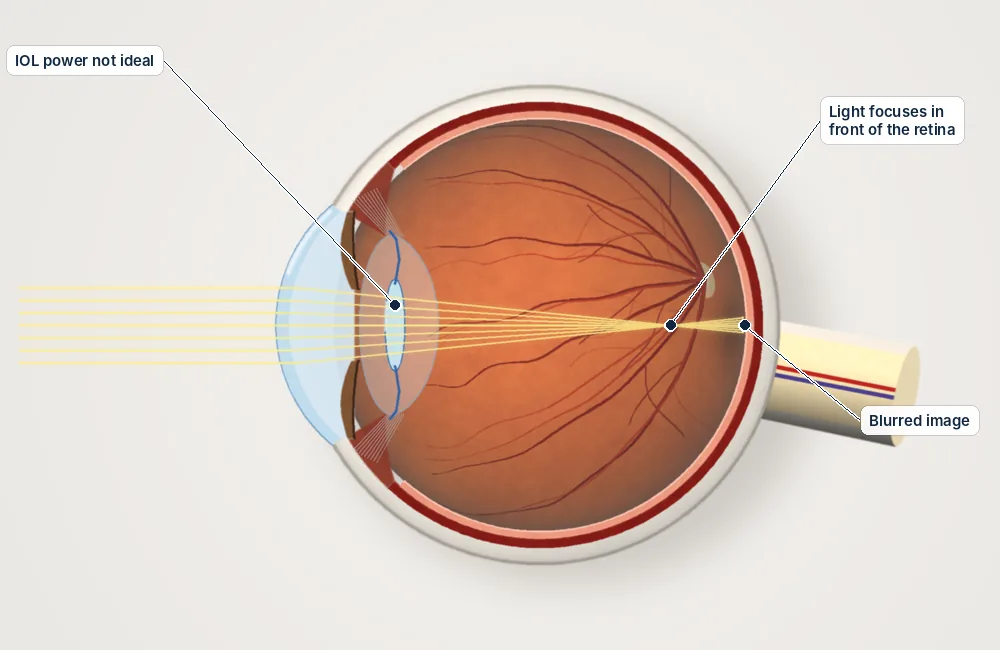
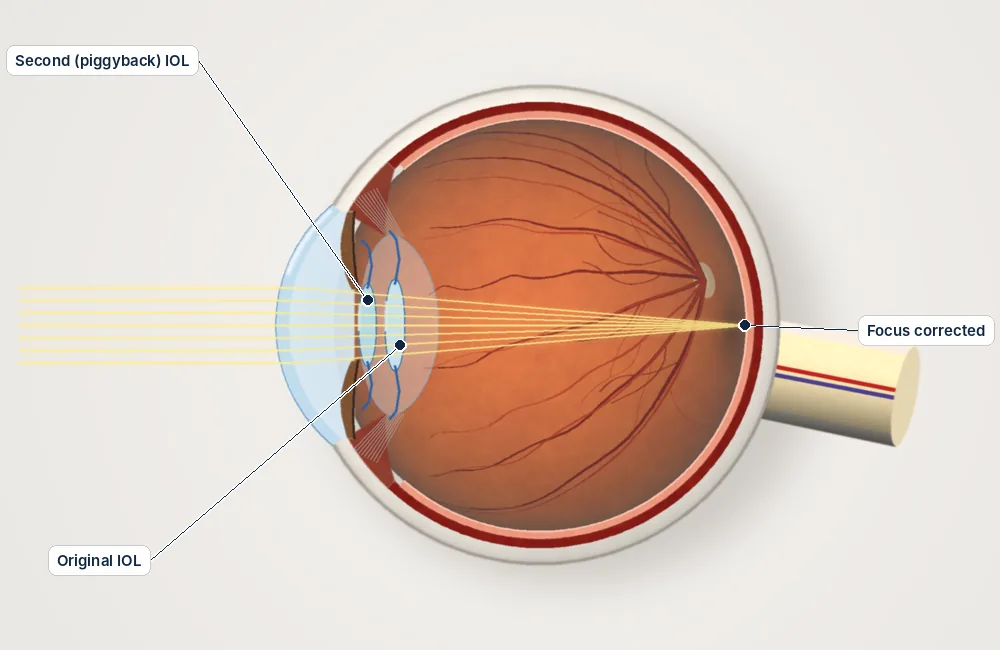
Inside the eye
When the lens implant power is not right, a second lens or a lens exchange can correct the focus.
Simplified diagrams for patient education, not to scale.
Understanding the risks
Every procedure carries some risk. These are approximate rates from published studies, grouped by how often they happen. They are averages, not a prediction for you; Dr Weaver will discuss your own risks before any treatment.
Aftercare guides| Risk | Approximate rate |
|---|---|
| Common, usually temporary or manageable | |
| Raised eye pressure | Common, usually temporary |
| Uncommon | |
| Swelling at the macula (CMO) | About 5–10 in 100 |
| Retinal detachment | About 1–2 in 100 |
| Rare but serious | |
| Infection inside the eye | About 1 in 1,000 |
Everything you need to know
Tap a topic to open it.
Overview
Dr Weaver has a particular interest in helping people whose cataract surgery result is not what they hoped. This includes replacing a lens implant, adding a second lens, and other repeat procedures. His training in retinal surgery is relevant to these more complex operations.
When the result is not ideal
Cataract surgery usually goes well. A small number of people end up with a result that is not ideal. The focus may be off, the lens may have moved or be unstable, or the lens may not suit them. These problems can often be corrected with a second operation.
Common reasons people ask about further surgery:
- Still very short-sighted, long-sighted or astigmatic after surgery
- Unhappy with a multifocal lens because of halos, glare or light effects that badly affect daily life
- The lens has moved out of position
- The lens is tilted or off-centre, causing blurred or distorted vision
- The lens bag has shrunk and is squeezing the lens out of shape
- No lens was put in at the original operation
Replacing the lens implant
Replacing a lens means taking out the original lens implant and putting in a new one. In the first few weeks to months after surgery, this is usually fairly straightforward and can be done through a small opening, like the original operation.
Later on, months or years after surgery, the lens becomes stuck inside its bag and is harder to remove. Dr Weaver manages these more complex replacements, including when the back of the lens bag is missing or damaged.
Adding a second lens (piggyback lens)
A piggyback lens is a second, thin lens placed in front of the existing lens implant, just behind the iris. It avoids the risks of taking the original lens out, and can correct a focus that is off after cataract surgery. Special lenses are made for this, including ones that also correct astigmatism.
A piggyback lens is especially useful when:
- The focus is well off and glasses do not correct it well
- Laser eye surgery is not suitable, for example because the cornea is thin or the correction needed is large
- The original lens is stable but simply the wrong strength
Lenses fixed to the wall of the eye
If there is no lens bag to hold a lens, for example after a complicated operation, an injury or weak support fibres, the new lens is fixed to the white wall of the eye (the sclera). Dr Weaver usually uses this approach, with stitches or the stitch-free method, for eyes without a lens and for lenses that have moved out of place.
Tests and planning
Careful planning matters for every repeat lens operation. This includes measuring the eye to work out the right lens strength, mapping the cornea (Pentacam) to check for astigmatism, a scan of the macula (OCT), and reviewing the notes from your first operation. Dr Weaver will talk through your options, likely results and risks at your appointment.
You may also want to read
Talk to Dr Weaver about your eyes
A referral from your GP or optometrist is needed to claim Medicare rebates. Our team can help with bookings at Robina and Tweed Heads.