
Cataract surgeryGold Coast & Tweed Heads
Clouding of the natural lens. Surgery replaces it with a clear lens implant chosen to suit your eyes and lifestyle.
- Routine and complex cataracts
- Day surgery
- Lens options to suit you
The short version
- What is it?
- Clouding of the clear lens inside your eye, which makes vision blurred, dull or dazzled by glare.
- Will I lose my sight?
- Cataract slowly blurs vision, but the vision it takes can usually be brought back with surgery.
- Can anything be done?
- Yes. Surgery replaces the cloudy lens with a clear lens implant. Glasses only help in the early stages.
- What does treatment involve?
- About 10 minutes of day surgery with the eye numbed and sedation. Eye drops for about 4 weeks.
- What if I do nothing?
- Nothing urgent happens, but vision keeps slowly getting worse. Very advanced cataracts make surgery more complex.
The key facts
What you may notice
- Blurred, dull or yellowed vision
- Glare and halos, especially driving at night
- Frequent changes to your glasses
How it is diagnosed
- Slit-lamp examination of the lens
- Biometry measures the eye for the lens implant
- Corneal imaging to check for astigmatism
How it is treated
- The cloudy lens is removed with ultrasound through a tiny incision
- A lens implant (IOL) is placed in the natural lens capsule
- About 10 minutes, with local anaesthetic and sedation
Recovery
- Eye drops for about 4 weeks
- Many people notice clearer vision within days
- New glasses, if needed, at about 4 weeks

Dr Travers Weaver
Dr Weaver is trained in both cataract and retinal surgery. This helps most when an eye has another condition as well, such as macular degeneration, an epiretinal membrane or previous retinal surgery, and when the lens is loose or has moved, which he can manage himself.
- FRANZCOSpecialist eye surgeon
- 2 extra yearsRetinal surgery training, Vancouver
- About 1,000Operations a year
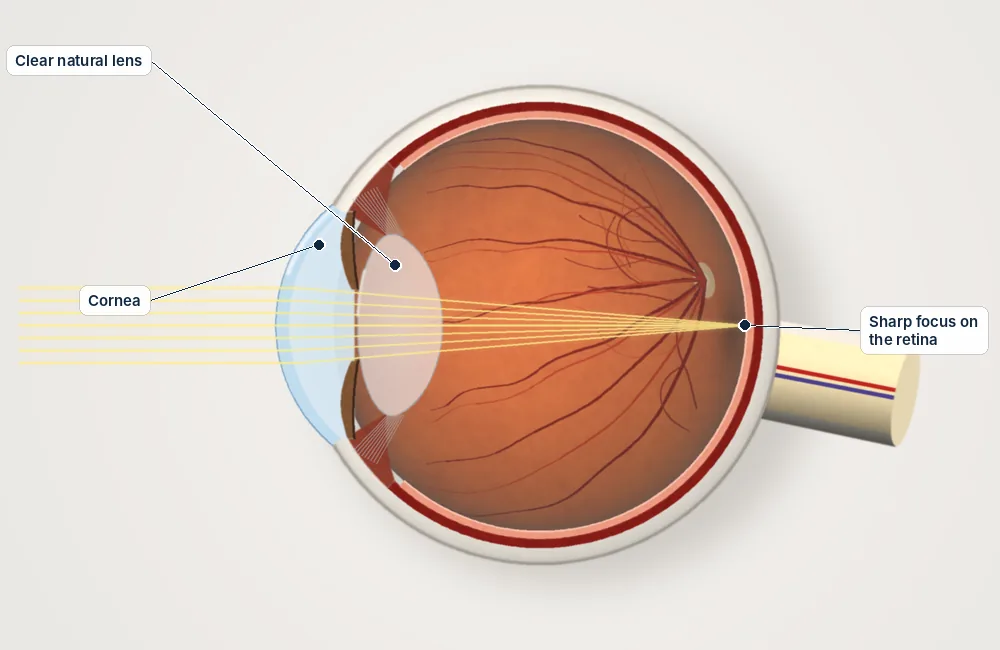
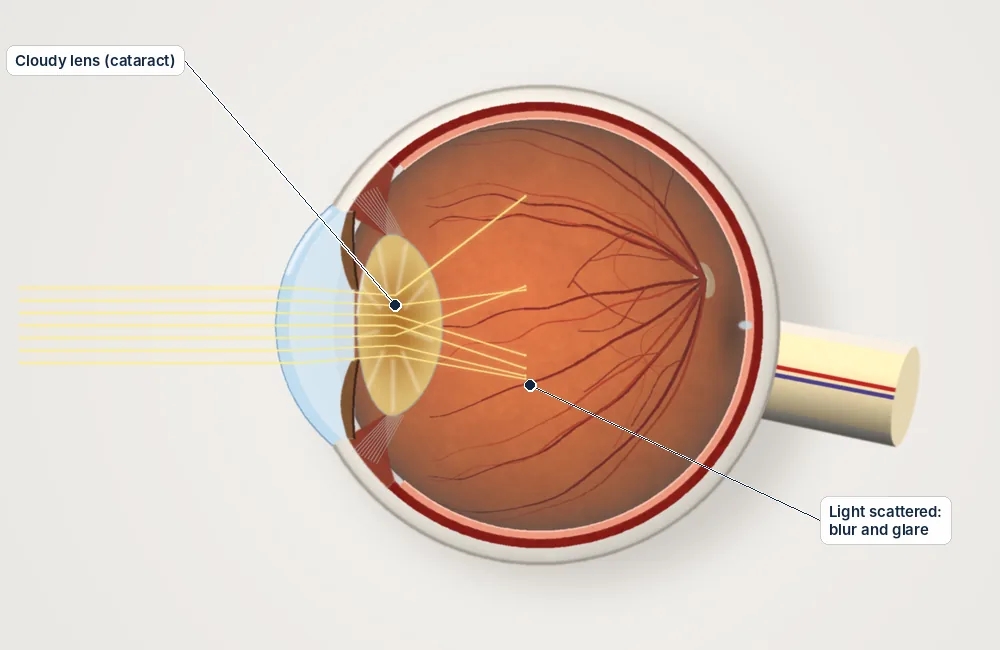
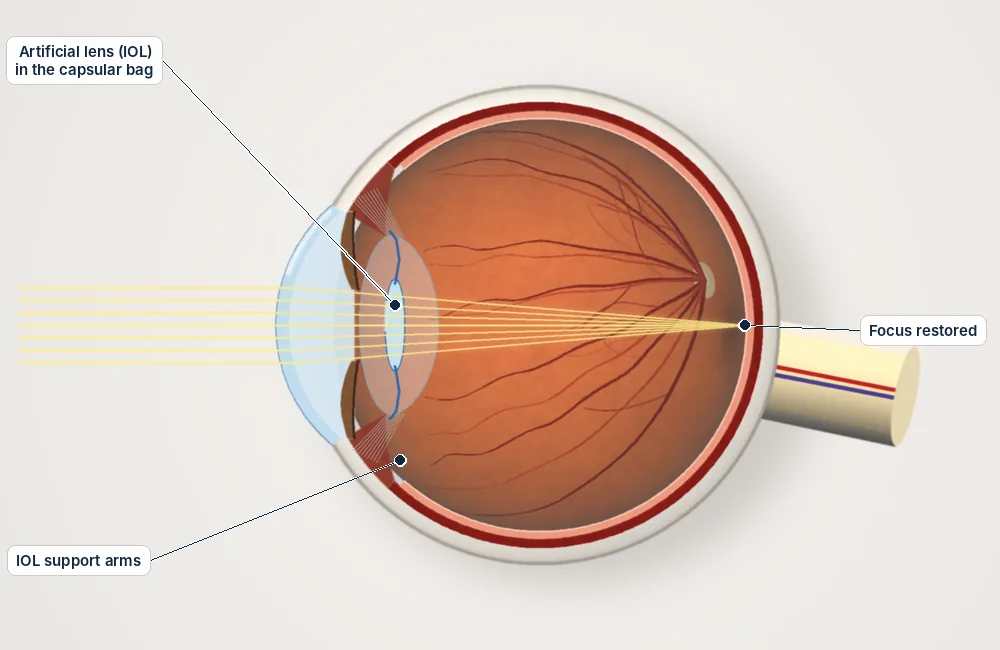
Inside the eye
A cataract scatters light; surgery replaces the cloudy lens with a clear artificial lens.
Simplified diagrams for patient education, not to scale.
Which Intraocular Lens Might Suit Me?
Answer a few questions to get a general guide to which lens type may suit your lifestyle. This is educational information only — your lens will be determined by Dr Weaver after a full clinical assessment.
Understanding the risks
Every procedure carries some risk. These are approximate rates from published studies, grouped by how often they happen. They are averages, not a prediction for you; Dr Weaver will discuss your own risks before any treatment.
Aftercare guides| Risk | Approximate rate |
|---|---|
| Common, usually temporary or manageable | |
| Clouding behind the lens implant (PCO) | Up to 1 in 2 over the years; fixed with a quick laser |
| Glasses still needed for some tasks | Common, depending on the lens chosen |
| Uncommon | |
| Tear in the lens capsule during surgery | About 1–2 in 100 |
| Swelling at the macula (CMO) | About 1–2 in 100, usually treated with drops |
| Rare but serious | |
| Infection inside the eye (endophthalmitis) | About 1 in 1,000–2,000 |
| Retinal detachment | Less than 1 in 100 |
Everything you need to know
Tap a topic to open it.
What is a cataract?
Inside your eye, behind the coloured iris, is a clear lens. It focuses light onto the retina at the back of the eye, a bit like the lens of a camera. With age, the lens slowly becomes cloudy. This cloudy lens is called a cataract. Light is scattered instead of focused, so vision becomes blurred, hazy or dazzled by glare.
Cataracts are the leading cause of blindness that can be fixed around the world. Most Australians over 70 have some cataract. Cataract surgery is one of the most common operations in medicine.
Symptoms
- Blurred, cloudy or hazy vision, like looking through frosted glass
- More glare, and halos around lights, especially when driving at night
- Colours look faded or yellow
- Your glasses prescription keeps changing
- Double vision in one eye
- Needing brighter light to read
- Reading without glasses briefly gets easier as the cataract changes the focus. This does not last.
Is cataract surgery right for me?
The decision is made with you, and depends on:
- How much the cataract affects your vision
- Whether it makes reading, driving or everyday tasks harder
- Glare, for example from headlights at night
- The health of your retina and optic nerve, which affects how much vision can improve
- Whether the cataract is stopping your retina from being properly checked or treated, for example in macular degeneration or diabetic eye disease
There is no need to wait until a cataract is "ripe". Very hard, advanced cataracts can make surgery more complex, so it is sensible to go ahead once it is affecting you.
Dr Weaver will talk with you about the best time for surgery and explain your lens options at your appointment.
The operation, step by step
Cataract surgery is done as day surgery. The eye is numbed and most people are given sedation. The operation itself usually takes about 10 minutes, and most people feel little or no discomfort.
Numbing the eye
Numbing drops are put in the eye. A small injection of local anaesthetic may also be given around the eye. Most people also have sedation through a drip, so they feel relaxed. Many people do not even realise the operation has been done when Dr Weaver tells them it is all over.
Tiny openings
Two tiny openings, less than 2.4 mm wide, are made at the edge of the clear front window of the eye (the cornea). They are so small that they usually seal on their own, without stitches.
Opening the lens bag
The natural lens sits inside a thin, clear bag. A neat, round opening is made in the front of the bag. The back of the bag is kept intact, to hold the new lens.
Removing the cataract
A fine probe uses ultrasound to break the cloudy lens into tiny pieces and gently suck them out (phacoemulsification).
Putting in the new lens
The new, artificial lens is folded, slipped in through the tiny opening, and unfolds inside the lens bag. In most cases no stitches are needed.
Choosing your new lens
Choosing the lens is one of the most important decisions in cataract surgery. Dr Weaver will consider how you use your eyes, your eye measurements and the health of your eye before recommending a lens. The new lens sits inside the natural lens bag, where the cataract used to be.
More expensive lenses are not better for everyone. For people with macular degeneration or other retinal conditions, a standard monofocal lens usually gives the clearest vision.
Monofocal lens
The standard lens. It gives clear vision at one distance, usually far away, and the best quality of vision of all lens types, with the fewest side effects such as halos. You will usually still need reading glasses. It is also the most suitable lens for people with other eye conditions, such as macular degeneration, glaucoma or diabetic eye disease.
Extended depth of focus lens
Gives clear vision from far away through to middle distance, such as a computer or car dashboard. You may still need glasses for small print. It causes fewer halos and less glare than a multifocal lens, and is a good middle ground for active people.
Multifocal lens
Aims to give clear vision far away, at middle distance and up close, so many people need glasses less. Some people see halos or starbursts around lights at night. It is not suitable for everyone.
Toric lens
Corrects astigmatism, where the front of the eye is shaped more like a rugby ball than a soccer ball. It comes in monofocal, extended depth of focus and multifocal versions, and gives sharper distance vision without glasses for people with astigmatism.
Complex cataract surgery
Because Dr Weaver is also trained in retinal surgery, he can manage more complex cataract situations himself, including:
- Eyes without a lens implant, or where the lens bag cannot hold one. Dr Weaver usually fixes the new lens to the wall of the eye (a scleral-fixated lens).
- Replacing a lens implant that is not working well or has moved
- Loose or weak lens supports: special rings and techniques keep the lens steady during surgery.
- Cataract and retinal surgery in the same operation, when both are needed
- Cataracts after an eye injury
- Very hard, advanced cataracts, which need extra care to remove
Recovery after cataract surgery
Day 1
Straight after surgery
You go home with a pad and a clear shield over the eye. Vision is often blurry at first. The pupil is often still wide, and some double vision is common while the anaesthetic wears off. Arrange a lift home, as you must not drive on the day of surgery.
Days 1 to 7
First week
Start your eye drops as directed, usually 4 times a day. Wear the shield at night for 1 week. Do not rub the eye. Avoid swimming, spas and dusty places for 2 weeks. Light activities are fine, but avoid heavy lifting and hard exercise.
Weeks 1 to 4
Getting better
Most people notice a big improvement within the first few days. Keep using your drops as directed and come to your follow-up visits. Avoid swimming and eye make-up for 2 weeks.
Month 1
New glasses
At about 4 weeks, once the eye has settled, update your glasses if needed. With a monofocal lens you will most likely need reading glasses for close work.
Cloudy vision months or years later
Months or years after surgery, the thin bag behind the new lens can turn cloudy, so vision becomes blurry again. This is called posterior capsule opacification (PCO). It happens to up to half of people over the years after surgery. It is not the cataract coming back. A quick laser treatment in the rooms (YAG laser capsulotomy) usually clears the vision within a day or so.
Everyday activities after surgery
Dr Weaver will give you instructions for your own eye, but as a general guide:
- Reading and television: fine from the day after surgery, as soon as it feels comfortable.
- Showering and washing your hair: fine from the next day. Keep soap and water out of the eye, for example by tilting your head back.
- Driving: not on the day of surgery. Dr Weaver will tell you at your check-up when your vision meets the driving standard.
- Gardening and dusty jobs: avoid for 2 weeks.
- Swimming and eye make-up: avoid for 2 weeks.
- Walking and light activity: fine straight away. Avoid heavy lifting and hard exercise for the first week.
- Your other eye: usually done 1 to 2 weeks later, once the first eye has settled.
Cataract surgery: common questions
How much does cataract surgery cost on the Gold Coast?
Costs depend on whether you have private hospital cover that includes cataract surgery, which hospital is used and the lens chosen. Medicare rebates apply. Dr Weaver is a known gap provider with all Australian health funds, which keeps the surgeon’s out-of-pocket cost down if you have suitable cover. If you do not have private health insurance, you can choose to pay for surgery yourself, with a full written estimate of the surgeon, anaesthetic and hospital fees before you decide. Public cataract surgery is available at Murwillumbah for eligible Northern NSW patients.
Where is cataract surgery performed?
Dr Weaver operates at Miami Private Hospital and Pacific Private Hospital on the Gold Coast, and Tweed Day Surgery in Tweed Heads. Public surgery is performed at Gold Coast University Hospital and, for Northern NSW patients, Murwillumbah District Hospital.
How long does cataract surgery take, and is it painful?
The operation itself usually takes about 10 minutes, as day surgery. The eye is numbed with drops or a local anaesthetic, and most people also have sedation. Many people do not even realise the operation has been done when they are told it is all over.
When can I drive after cataract surgery?
Not on the day of surgery. Many people can drive within a few days, once their vision meets the driving standard. Dr Weaver will advise you at your follow-up visit.
Are both eyes done on the same day?
Usually not. Each eye is treated separately, typically one to two weeks apart, so the first eye can settle and the lens choice for the second eye can be confirmed.
Do I need a referral?
Yes. A referral from your GP or optometrist is needed to claim Medicare rebates for the consultation and surgery.
You may also want to read
Talk to Dr Weaver about your eyes
A referral from your GP or optometrist is needed to claim Medicare rebates. Our team can help with bookings at Robina and Tweed Heads.