
 Written by Dr Travers Weaver, FRANZCO
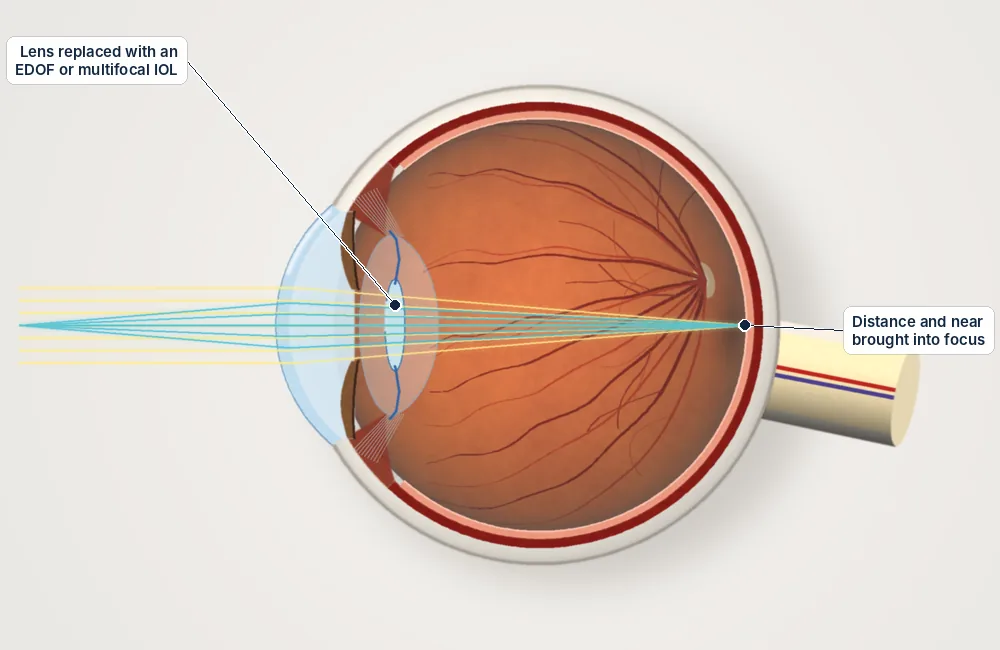
Many people in their 40s and 50s notice they are holding their phone further away. This is presbyopia: the natural lens inside the eye gradually stiffens and loses its ability to focus up close. Later in life, the same lens becomes cloudy, which is a cataract.
The same operation, for different reasons
Cataract surgery removes a lens that has become cloudy and replaces it with a clear lens implant (IOL). Refractive lens exchange (RLE) uses the same technique, but the natural lens is replaced before a cataract has formed, mainly to reduce reliance on glasses.
Lens options
- Monofocal lenses focus clearly at one distance, usually far, and reading glasses are needed for close work.
- Extended depth of focus (EDOF) lenses give a wider range from distance to intermediate.
- Multifocal lenses aim to provide distance, intermediate and near vision, with a higher chance of halos at night.
- Toric versions correct astigmatism.
Funding
Medicare rebates apply to cataract surgery, and private health insurance helps cover it if your policy includes cataracts (they are included in all Gold-tier hospital policies, but are optional on lower tiers). Refractive lens exchange is considered elective and is not covered by health funds; you will receive a written quote.
Is it right for me?
Suitability depends on your prescription, the health of your retina and cornea, and your visual needs. A thorough assessment with biometry, corneal imaging and an OCT scan is the first step. Any surgery carries risks, and you should consider a second opinion before proceeding.
This article is general information and does not replace individual medical advice.